
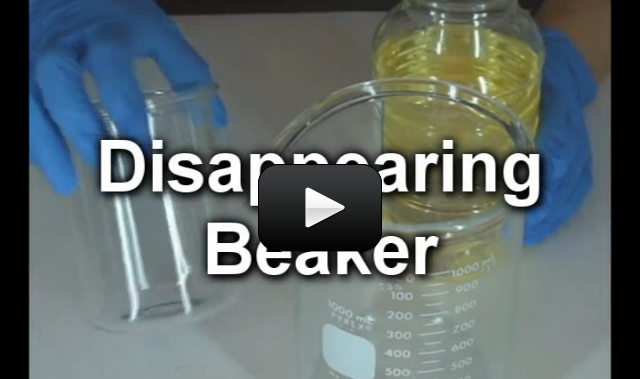
We’re going to bend light to make objects disappear. You’ll need two glass containers (one that fits inside the other), and the smaller one MUST be Pyrex. It’s okay if your Pyrex glass has markings on the side. Use cooking oil such as canola oil, olive oil, or others to see which makes yours truly disappear. You can also try mineral oil or Karo syrup, although these tend to be more sensitive to temperature and aren’t as evenly matched with the Pyrex as the first choices mentioned above.
Here’s what you need:
- two glass containers, one of which MUST be Pyrex glass
- vegetable oil (cheap canola brand is what we used in the video)
- sink
Published value for light speed is 299,792,458 m/s = 186,282 miles/second = 670,616,629 mph
Please login or register to read the rest of this content.
Awesome!!!!!!!
The first time we used vegetable oil. Then we tried olive oil. Then we used coconut oil. They all work. But with coconut oil you can see the oil is disturbed. Anchor works as well as Pyrex. They’re made of the same material. (or close enough.) We did it a second time using vegetable oil in the big container and coconut oil in the top small one. Coconut oil bubbles on the bottom,(When we did it at least.) so we could tell the difference. But, you still couldn’t see the container! We then replaced the coconut oil with olive oil. Only the colors alerted you there was something fishy! Now, if the two oils where colored the same color, you wouldn’t tell the difference at all. (That, or being color blind!)
Cool experiment.
Thanks for writing! It’s actually really hard to make enough sodium acetate for the Hot Sculptures experiments using this method, so I recommend getting the hand warmer instead. Here’s the safety info for sodium acetate: http://www.sciencelab.com/msds.php?msdsId=9924952 I always have kids wear both gloves and goggles when doing chemistry experiments, because that’s the good habits we want them to get used to so when they get older and do more extensive experiments, they already know they need to slap both of those on, because you never know what might come up with their experiment, especially ones they are not familiar with.
Trying to make sodium
Acetate at home. Boiled vinegar and baking soda together (didn’t wor). But now watched your experiment with the hand warmers and you say not to touch sodium acetate. Can I now reuse the pot I boiled vinegar and baking soda in? Or do I need to throw it away. Or does the commercial hand warmers have something else in them that makes them dangerous to touch?
Fun project!!!
wow
nice. I like science i’m 10 thx for ur videos
Thanks, Aurora! We really had fun with this experiment! 🙂
Read over the info under the post – it will help explain it! 🙂 The basic idea is that light passes through the oil and the glass the same way so you can’t tell one from the other optically.
how does this work the disapearing beaker
You need the glassware to have the same optical index of refraction as the liquid in it so it will appear the same to your eyes. Water is a different optical density than Pyrex, even through they kind of look the same. It’s the way that light passes through it that makes the difference.
yes!!!!!!!!!!!! thank you!!
why do you have to use pyrex ?.And why won’t water work? From Ellie Newbanks.
Pyrex has the same optical density (index of refraction) as water, which means you can’t tell the difference between one and the other because they look the same the way light hits it. Does that make sense?
Why does it have to be pyrex glass?
Awww… !! 🙂
Fun! Not sure which was more interesting, watching the disappearing act or my daughter’s eyes light up when it happened. Thanks!
Yes – that will work!
can i use pyrex for both the inner and outer containers?
We can’t wait to try this. 🙂
Pyrex is a glass product first produced by Corning Glass Works. Pyrex contains boric acid and silica sand that, processed for many hours under extremely high temperatures. The resulting borosilicate glass is used for household baking dishes, laboratory glassware, and any application that requires resistance to heat and chemical reactions.
what is pyrax
It’s cool how the smaller jar disappears,I think i’ll do this experiment.
It was pretty cool. 🙂
My Kids Loved this experiment! Thanks Aurora!
Unbeleveble!!!!!!!!Super cool.If it wasn’t science it
would be magic.
once i did something like this with water. you put a glass cup into a bowl of water and it looks like there is a hole in the water.
Whoa! That’s SOOOOOOOOOOOO cool!!!!!!!!!! 😀
-Charli(7th grader)
This was a great experiment. Although I didn’t have a typical “Pyrex” jar, we used a small jar that I have for making yogurt. It’s a six ounce heat tempered jar and instead of “canola” oil, we used peanut oil which is lighter in color. It worked great. My daughter was excited to see it worked. Wish I could’ve taken pictures!!!
Cool
When light goes through the air and then hits a glass surface at an angle, some of the light bounces and reflects off the surface and the rest goes through the glass but it bends as it moves through the glass. When light goes from air into glass, it slows down (it’s this change of speed that makes the light reflect and refract).
Every material has a specific “index of refraction” that is related to speed of light in the material. The higher a material’s index of refraction, the slower light travels in that material.
Cooking oil has about the same index of refraction as Pyrex glass (1.474), but different glasses will have different values for their index of refraction. Notice how I said ‘about the same’. You can see a ghostly image of the beaker inside because the beaker has internal strains embedded in the glass that slightly change the index of refraction at different locations. The index of refraction changes with temperature, so you might find that this demonstration works better on some days than others.
Why does the pyrex glass have the same index of refraction as the oil, is there something alike between them?
Also, what is the index of refraction / optical density of regular glass?
No – it’s just cooking oil you are working with.
do we need rubber gloves to do it
You can find them here.
Where can I get a Pyrex beaker?
Pyrex has the same index of refraction as the oil, which means your eye can’t tell the difference between the two visually because passes through both the same way. Look at the trading material for more info on this, and ask me lots of questions!
What is pyrex, and why does it work?
I love these experiments. Keep them coming
Oops! Looks like I missed a question – sorry about that!
As the index of refraction value increases, the optical density increases, and the speed of light in that material decreases. For a vacuum, the index of refraction is 1.0000 (lowest optical density), and this is where light travels fastest. The index of refraction values give us a way to measure of the relative speed of a light wave in a particular material or medium. If we know the relative speeds, we can predict which way light bends when moving from one medium to another. Does this help?
Hi! I asked these questions last week and I don’t see any answers to them. I am teaching to my high schooler so I am interested in giving him the correct terminology and science. Could you please answer the questions below? Thanks.
How does optical density affect the index of refraction (e.g. as in your chart)? Am I correct in remembering that the higher the optical density then the higher the index of refraction? OR am I really off-base here?
How does optical density affect the index of refraction (e.g. as in your chart)? Am I correct in remembering that the higher the optical density then the higher the index of refraction? OR am I really off-base here?
I found them here – you can also remove the markings with a razor and a few sprays of window cleaner.
Where can you get unlabeled pyrex beakers (like in your video)?
WOOOOOOOAAAAAAHHHHH! THAT IS AMAZING!!! I AM GOING TO TRY THIS!!!!
…
WOOOOOOOOOAAAAHH!!!
Ooooh aaaah. Very cool. Will try this. Thanks!
My eight year old son loves these experiments! We have done two so far and have balanced each with reading and researching about what actually occurred and why. He loved it. I think it really brings the learning alive and gives him a reason to want to learn something. So far so good. Thank goodness I found this!
Pyrex has the same ‘light-bending’ ability as oil (same index of refraction). You can read about other things that will work in addition to Pyrex in the reading download. 🙂
Why Pyrex?
What web browser are you using? Try Firefox if you have it installed. If not, try a different computer. Does it work now?
The video is not working 🙁
Whoa… that’s so weird how it works!