
Rockets shoot skyward with massive amounts of thrust, produced by chemical reaction or air pressure. Scientists create the thrust force by shoving a lot of gas (either air itself, or the gas left over from the combustion of a propellant) out small exit nozzles.
According to the universal laws of motion, for every action, there is equal and opposite reaction. If flames shoot out of the rocket downwards, the rocket itself will soar upwards. It’s the same thing if you blow up a balloon and let it go—the air inside the balloon goes to the left, and the balloon zips off to the right (at least, initially, until the balloon neck turns into a thrust-vectored nozzle, but don’t be concerned about that just now).
A rocket has a few parts different from an airplane. One of the main differences is the absence of wings. Rockets utilize fins, which help steer the rocket, while airplanes use wings to generate lift. Rocket fins are more like the rudder of an airplane than the wings.
Another difference is the how rockets get their speed. Airplanes generate thrust from a rotating blade, whereas rockets get their movement by squeezing down a high-energy gaseous flow and squeezing it out a tiny exit hole.
If you’ve ever used a garden hose, you already know how to make the water stream out faster by placing your thumb over the end of the hose. You’re decreasing the amount of area the water has to exit the hose, but there’s still the same amount of water flowing out, so the water compensates by increasing its velocity. This is the secret to converging rocket nozzles—squeeze the flow down and out a small exit hole to increase velocity.
There comes a point, however, when you can’t get any more speed out of the gas, no matter how much you squeeze it down. This is called “choking” the flow. When you get to this point, the gas is traveling at the speed of sound (around 700 mph, or Mach 1). Scientists found that if they gradually un-squeeze the flow in this choked state, the flow speed actually continues to increase. This is how we get rockets to move at supersonic speeds or above Mach 1.
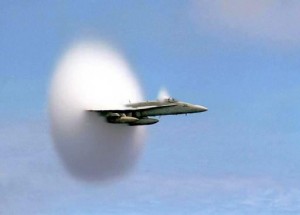 The image shown here is a real picture of an aircraft as it breaks the sound barrier. This aircraft is passing the speed at which sounds travel. The white cloud you see in the photo is related to the shock waves that are forming around the craft as it moves into supersonic speeds. Because the aircraft is moving through air, which is a gas, the gas can compress and results in a shock wave.
You can think of a shock wave as big pressure front. In this photo, the pressure is condensing water vapor in the air, hence the cloud. There are lots of things on earth that break the sound barrier – bullets and bullwhips, for example. The loud crack from a whip is the tip zipping faster than the speed of sound.
The rockets we're about to build get their thrust by generating enough pressure and releasing that pressure very quickly. You will generate pressure both by pumping and by chemical reaction, which generates gaseous products. Let's get started!
For this experiment, you will need:
We did this experiment and at first used some random little containers I had sitting around – that had stretchy rubber lids. Second try, we used a plastic cream cheese container, and that worked as in it made a loud POP! but it didn’t go anywhere. I varied the amounts of baking soda vs. vinegar until we ran out of baking soda…
Any suggestions?
Thanks!
If you haven’t yet completed Algebra 1 & 2, then the advanced exercises will be more challenging. I’ve put together an overview course to show you the basics, so please view it here: https://www.sciencelearningspace2.com/math/category/math-topics/algebra/
Please email [email protected]. Let me know the problems you’re struggling with and where you are getting stuck.
Hi Aurora! I’m struggling to figure out the problems, I can see the answers but don’t understand how you solved them. Like robinwilliams246 said I don’t see any videos with step-by-step instructions. Help!
I don’t see any videos that show how to work problems.
If this is the first time you’re doing these types of physics calculations, you’ll want to look here for the step-by-step videos that show you how to do the analysis and use the equations. You’ll also find a downloadable homework set and a solutions set with all the problems worked out in detail. Go here: https://www.sciencelearningspace2.com/grade-levels/high-school/advanced-physics/1-d-kinematics/
We are really struggling with the math on the pop rockets problems. Where can we find instruction for that?
And… DO IT OUTSIDE!!! XD
Hobby Lobby has some pretty good little, plastic canisters 🙂
Yes, M&Ms Minis containers are also GREAT! 🙂 LOL You get chocolate as well as a super cool experiment! 😉 😉
You can check with a local camera store to see if they have any extras, or if they can save some for you. Another great option are the M&Ms Minis containers. Those work great for this experiment 🙂
where can you buy film canisters
thanks a lot i will ask my mom to buy one or i can buy one with my money
Hi, Harry! You can get Alka Seltzer tablets from the grocery store or pharmacy. You can probably find M&M tubes there as well. They look like this.
🙂
oh and my name is harry! 😉
umm… were do you get all of this stuff to make it?
So cool 😉 We did this outside, sometimes it worked, sometimes it didn’t. However after much practice we figured out the best amount of water vs baking soda, then it worked great. We needed to stop because well….we lost our film canister.LOL My daughter said it is probably in space. Had a lot of fun with this.
I think that its the water that give it flight cos the water is going down and puping the rocket up I may be rong
Thakins
Oops sorry about that! I’ve uploaded the new one. Try again?
um? the 2th video was the same as the 1th
The ones in this section “Easy Experiments” are the ones listed under “Getting Started with the program”. They are simple experiments that use easy to get materials so get your kids excited to start the program. Once you are ready to start the program (you don’t have to do the easy ones at all), pick the topic or grade level by using the buttons at the top of the screen.
ALso – did you find the Getting Started tab that has a “How to get the most out this website” video?
There is a link at the top of this page on the right side tool bar that says “Easy Experiments and Videos”. Are these experiments specifically for this section of the physics program that should be done before moving on to “Graphing”? I am desperately trying to figure out how to use your program.
Yes – try it!
can do this with baking soda and vinegar
Hi, this was awesome. It work and we have to do it outside because it went so high.
Awesome! Great job!!
Hi, my name is Earnest. The M & M canister worked well. It took about 50seconds for it to launch, and my! It was so exciting! We saw it launch and even heard a loud POP!
I am sorry it didn’t work the first time or two you tried this experiment. There’s a greater lesson here, if you are up to teaching it. This is a great opportunity for you to show them how science is like the real world… how things don’t work the way you expect, and you need to not only have determination but also flexibility in achieving your goal. The goal here might only look like getting a little experiment to work, but it’s how you model yourself when things don’t work out that they really learn more than they would if it worked the first time. You’re kids are lucky to have someone that is able to show them how to step up and learn from the unexpected.
My personal definition of failure is: if I don’t learn something. So if it were me, I actually get excited when stuff doesn’t work the way I want it to, because it means that I am about to learn something I didn’t know before, which really lights me up!
Of course, it’s totally up to you in how to handle it, but I totally encourage you to show your kids how to handle the disappointments and frustrations now when they’re young, because more of that is sure to come in life!
P.S. Try a bottle with a tight-fitting cork…
Couldn’t find the old film canisters. Tried the M&M’s canisters, but they flopped. A great disappointment fell over our house. Now the kids are not excited about science at all.
so cooi
Yes! That’s what in inside the table also (along with a powdered form of acetic acid.)
Would it work to put in baking soda?
So cool! We’re trying this tonight!!
amazing !
This was awesome!
Yes you can try these with club soda (soda water) and see what happens! 🙂
how about soda rockets
We couldn’t find any film canisters so we found some of those plastic ball type things that panty hose come in at the drug store. We took out the panty hose and tried it out and it worked great! It makes a great “popping” sound too! My four year old loved it!
hi my name is elijah Our FAST reaction 🙂 was about 45 FEET!!
hi my name is elijah AND MY WENT 40 FEET WE LOVED IT